
Baihui Cryogenic Equipment
Huzhou Baihui Cryogenic Equipment Co., Ltd
Huzhou Baihui Cryogenic Equipment Co., Ltd

Provide you with the latest enterprise and industry news
Selecting a cryogenic pump is not simply a matter of choosing a model with the required motor power or connection size. The correct pump must match the liquid, required discharge pressure, flow rate, operating pattern, suction conditions and installation environment.
Reciprocating, centrifugal and submerged pumps are commonly used in LNG and industrial gas systems. Each type has distinct advantages, but they are designed for different duties. Understanding these differences is the step toward reliable cryogenic pump selection.
A reciprocating cryogenic pump is a positive-displacement pump. A piston or plunger draws a fixed volume of liquid into the cold end and then pushes it toward the discharge side. This operating principle allows the pump to generate high pressure even when the required flow is relatively limited.
A cryogenic centrifugal pump uses a rotating impeller to add velocity and pressure to the liquid. It is generally selected when the application requires continuous, stable transfer at a medium or high flow rate.
A submerged cryogenic pump is usually also a centrifugal pump. The main difference is its installation arrangement: the pump—and often the motor—is positioned inside the cryogenic liquid or within a pump sump. This provides flooded suction and reduces the amount of heat entering the liquid through external suction piping.
Therefore, “centrifugal” describes the hydraulic principle, while “submerged” mainly describes how and where the pump is installed.
A reciprocating pump is normally the preferred option when pressure is more important than flow.
During industrial gas cylinder filling, for example, liquid oxygen, nitrogen, argon or carbon dioxide must be pressurized before entering a vaporizer and the downstream filling system. L-CNG stations also require a high-pressure pump to pressurize LNG before vaporization.
These applications are well suited to reciprocating pumps because the pump can develop high discharge pressure without requiring a very large flow rate. Duplex or triplex arrangements can be used when higher capacity, reduced pulsation or greater operational flexibility is needed.
Typical applications include:
However, reciprocating pumps produce pulsating flow rather than the nearly continuous flow associated with centrifugal pumps. Their suction and discharge valves, piston rings, seals and other wear components also require regular inspection.
Good inlet conditions remain essential. If vapor enters the cold end, volumetric efficiency can fall and the pump may experience unstable pressure, vibration or abnormal valve loading. Correct pre-cooling, proper suction-pipe design and sufficient tank pressure are therefore important.
A centrifugal pump is generally more suitable when the system requires continuous transfer and a comparatively high flow rate.
The rotating impeller creates a smooth flow, making this pump type suitable for unloading tankers, transferring liquid between storage vessels, circulating cryogenic liquid or supplying downstream equipment.
Single-stage centrifugal pumps are commonly used for lower-pressure transfer duties. Multistage designs can generate greater pressure while retaining the continuous-flow characteristics of a centrifugal pump.
Typical applications include:
A centrifugal pump should normally operate within its intended performance range. Operating too far below or above the recommended flow can reduce efficiency and increase vibration, recirculation or mechanical loading.
It is also more sensitive to inlet conditions than many users expect. Cryogenic liquids are often close to their boiling point, so heat entering the suction line or an excessive pressure drop can generate vapor. This can reduce pump head and to cavitation.
For this reason, centrifugal pump selection must consider not only the required flow and discharge pressure, but also available NPSH, tank pressure, liquid level, piping resistance and liquid temperature.
A submerged pump is especially useful when the system requires stable flooded suction, low heat leakage and compact tank-integrated installation.
Because the pump inlet remains below the liquid surface, the system can avoid a long external suction line. This helps reduce suction losses, heat ingress and the risk of vapor formation before the liquid reaches the impeller.
Submerged pumps are widely used in LNG filling stations, storage tanks, terminals, vehicle-fueling systems and other applications that require rapid, dependable liquid delivery.
Typical applications include:
A submerged design may also reduce product leakage because some configurations eliminate an external rotating shaft seal. The surrounding liquid helps keep the pump cold and ready for operation, which can shorten response time compared with a warm external pump.
The trade-off is that inspection and maintenance can be more involved. The equipment may need to be removed from a tank, pump well or sump. Tank design, electrical connections, cable feedthroughs and equipment lifting arrangements must therefore be considered during the system-design stage.
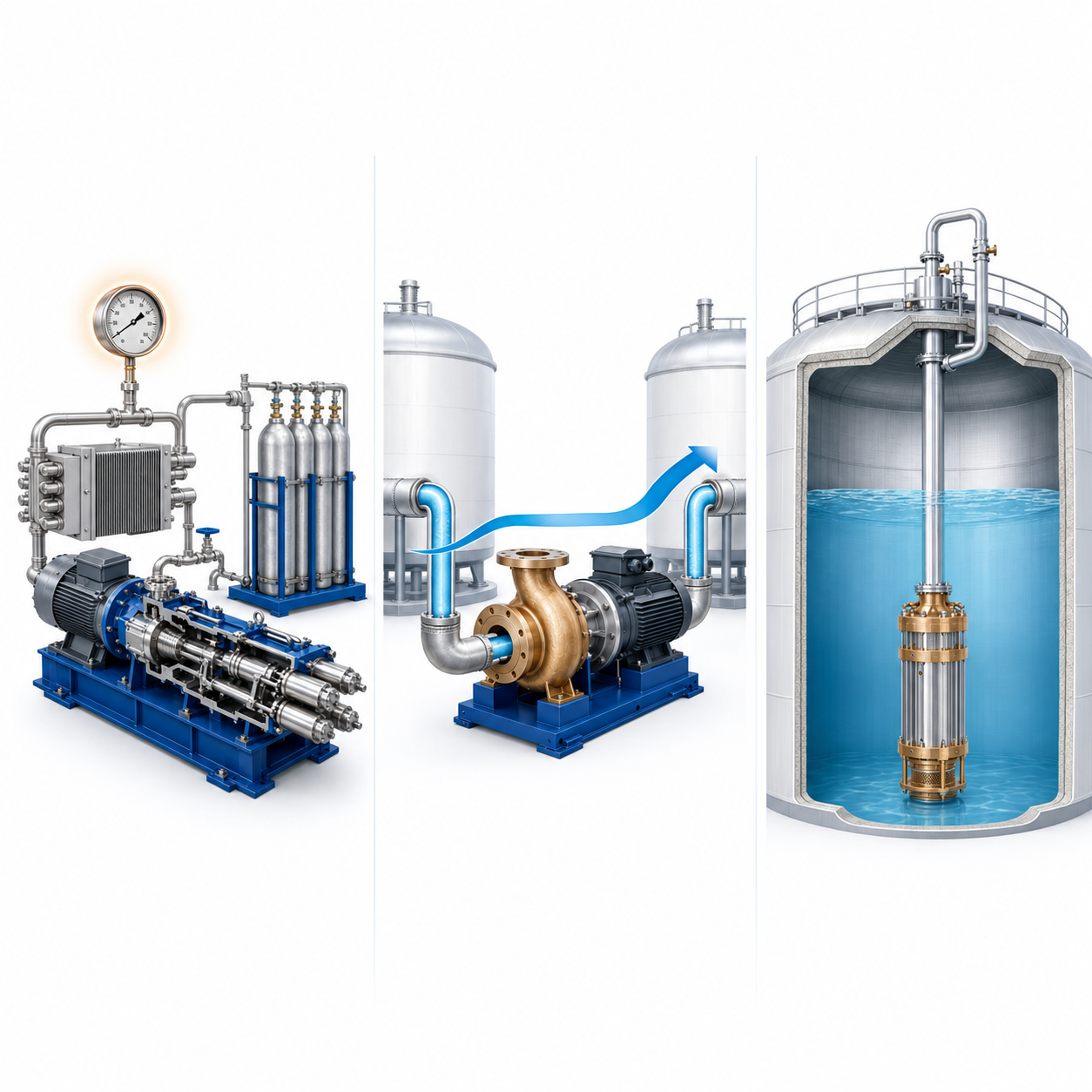
| Selection factor | Reciprocating pump | External centrifugal pump | Submerged pump |
|---|---|---|---|
| Main advantage | High discharge pressure | Continuous, higher-volume transfer | Flooded suction and low heat ingress |
| Typical flow | Low to medium | Medium to high | Medium to high |
| Typical pressure duty | High to very high | Low to medium; higher with multistage designs | Depends on stage design and application |
| Flow characteristic | Pulsating | Smooth and continuous | Smooth and continuous |
| Common applications | Cylinder filling, L-CNG, high-pressure gas supply | Tanker unloading, storage transfer, circulation | LNG fueling, in-tank transfer and send-out |
| Installation | External cold end connected to drive | Usually external or skid-mounted | Installed in a tank, sump or pump well |
| Main selection concern | Valves, seals, pulsation and inlet vapor | NPSH, cavitation and operating range | Tank integration, removal and maintenance access |
The values above are general tendencies rather than fixed limits. Actual performance depends on the pump model, number of stages, speed, configuration and process design.
Start by identifying the main requirement of the system.
If the process requires very high discharge pressure and only a limited or moderate flow, a reciprocating cryogenic pump is usually the option to evaluate.
If the process requires continuous transfer at a relatively high flow rate, an external centrifugal pump is generally more appropriate.
If the pump must operate inside a storage tank or pump sump—and reducing suction losses and heat ingress is a priority—a submerged centrifugal pump may offer the better system arrangement.
The choice becomes more accurate when pressure and flow are considered together with duty cycle. A pump used intermittently for cylinder filling faces different operating conditions from one used continuously in a process plant. Frequent starts, cold-standby requirements, available maintenance access and expected annual operating hours may all influence the final configuration.
A pump suitable for one cryogenic liquid should not automatically be assumed suitable for another.
LNG, liquid oxygen, liquid nitrogen, liquid argon, liquid carbon dioxide and other refrigerated liquids have different temperatures, densities, vapor pressures and material-compatibility requirements.
Liquid oxygen service requires particularly strict attention to material cleanliness, lubricant compatibility and contamination control. LNG systems must consider flammability, gas-tight construction and hazardous-area requirements. Some liquids may also require special seals, bearings or component materials.
The medium must therefore be confirmed before pump selection begins.
A reliable recommendation requires more than a general statement such as “we need an LNG pump.” The following operating data should be provided whenever possible:
The complete system should also be evaluated. A correctly selected pump may still perform poorly if the suction pipe is undersized, the pre-cooling return is inadequate, the tank pressure is unstable or excessive heat enters the liquid before it reaches the pump.
There is no single cryogenic pump type that is best for every application.
Reciprocating pumps are strong candidates for high-pressure duties. Centrifugal pumps are generally better suited to continuous, higher-flow transfer. Submerged pumps provide valuable advantages when flooded suction, low heat ingress and tank-integrated installation are priorities.
The final decision should be based on the complete operating conditions rather than pressure or flow alone.
Huzhou Baihui Cryogenic Equipment Co., Ltd. supplies L-CNG high-pressure reciprocating pumps, industrial gas filling pumps, cryogenic centrifugal pumps, LNG submerged pumps and integrated skid-mounted systems. By evaluating the medium, required pressure, flow, suction conditions and installation environment, we help customers identify a pump configuration that matches the actual process requirement.
 Add: Building A38, China Energy Conservation and Environmental Protection Industrial Park, No. 1506, Yishan Road, Wuxing District, Huzhou City, Zhejiang Province, China
 Phone: +86-13757082585
Telphone: +86-572-2382905
 E-Mail: [email protected]
Copyright © Huzhou Baihui Cryogenic Equipment Co.,Ltd All Rights Reserved.

 English
 русский
 Español